

What the heck are tins for? I mean, tins with food inside. Why have we still got them?
Tins come from an era before we discovered fridges and freezers, and when all that was available was to do strange things to food to preserve it.
Stopping food fill itself with maggots obviously occupied humans some time ago, after they sussed that maggots didn’t really enhance the flavour. Not to mention the fact that they enhanced illnesses.
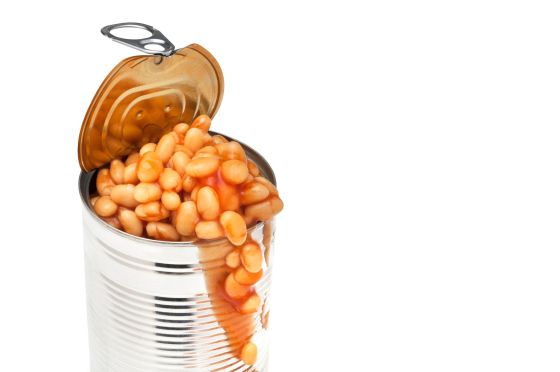 We discovered the concept of making preserves, like jams and the like, and cheese. We discovered we could do quite a few things to certain foods in order that they either wouldn’t go mouldy, or at the very least would take a long time before going mouldy. Clever us.
We discovered that keeping cooked items in a ‘juice’ in an air-tight container made them last longer, and after many many centuries we worked out that we could put things in tins (which we invented for that very purpose) and they’d last a considerably long time.
So, that’s how we came to start using tins. And for many decades it was an efficient method of storage and distribution of a whole range of foods.
The only problem, which persists to this day, is that any food that is served from a tin will always taste of, well, tin. It doesn’t matter if it’s a fruit salad or a tomato soup. It tastes of tin.
I only discovered that baked beans have a quite attractive taste when I found a large portion being sold in a resealable plastic container. They didn’t taste of tin any more. They tasted really nice.
But why do we still sell stuff in tins? And who buys it?
I mean, do we still stock tins purely for the old people who love a tin of ‘Evap’ for their tea, and pears halves for dessert? Do young people buy tinned food?
It’s all a mystery. By rights, tins shouldn’t be there any more. Plastic containers or frozen versions have got to be nicer, right? No taste of tin.
Or am I missing the obvious? Zombie apocalypse.
When the Zombie apocalypse happens, we’ll need emergency supplies. And they’ll be in tins.
Tins are probably very useful if you live on a flood plain in Britian, too. But do they float?

 England's England
Tinned food has some very big advantages over chilled or frozen food , and has a astronomically longer shelf life. It is also far more energy efficient , ans so costs consumers less overall. Tinned food does not need to be kept chilled or frozen while on display in the shop , or stored at a distribution warehouse. There’s no urgency to get it home once it’s been bought as it will last virtually forever at room temperature.
There is far less chance of the food becoming contaminated with any type of food poisoning as a result of being open to the air for too long – basically no chance at all.Tins can be dangerous when opened with their sharp edges , but are completely recyclable , so are more sustainable than food sold as chilled that is wrapped in plastic and polystyrene. Tinned food is still the best way to keep a reserve of food at home in case of adverse weather , or other unpredictable scenario where you might not be able to just go out and buy fresh or frozen provisions.
LikeLike