

Many years ago before the mp3 was invented and the ability to ‘segue’ songs (play them one after the other with no silence inbetween) became an essential of even the smallest playback device, it was accepted that there would be gaps inbetween the songs.
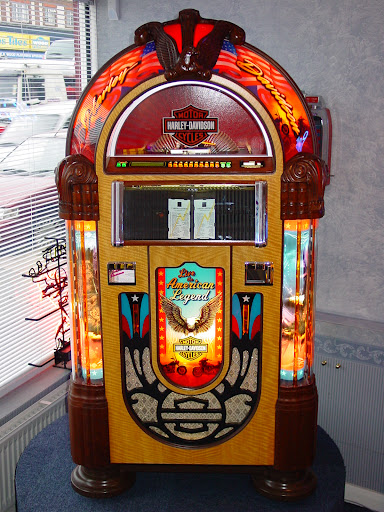
The most common device used for playing song after song was the jukebox. This mechanical device would physically load actual ‘records’ onto a turntable, drop an arm and stylus (‘needle’) onto it and then play it. When the ‘record’ came to an end, and once the jukebox had mechanically worked out that the ‘needle’ had reached the final loop track, the arm would be lifted out of the way and the ‘record’ would be grabbed and carefully taken away from the turntable and back to a dedicated rack where it would be slipped into a slot alongside all the other ‘records’. Then the mechanics would drive to the next ‘record’ that had been selected from the rack, collect it and move it to the turntable. Finally the arm with the needle would drop onto the record. After a few seconds of playing the silent run-in groove, the song would start.
The whole process would take anything up to 30 seconds of silence, or ‘non-song‘, until there was a ‘song‘ again.
People were used to waiting during a short regular break of ‘non-song‘ after each ‘song‘ before the next ‘song‘. It was rhythmic like a heartbeat. It was acceptable.
It would have been a little bit weird if the jukeboxes had managed to play 3 or 4 songs without any ‘non-song‘ spaces and had then provided 7 minutes of continuous ‘non-song‘.
Weird, and also boring.
A complete party-pooper having 15 minutes of songs followed by 7 minutes of silence (non-song), followed by 15 minutes of songs.
Complete madness. Nobody would want this, right?
So why does commercial music radio do exactly this?
Assuming that all the evidence seems to be correct, and commercial music radio has driven all ‘radio’ listeners away in favour of those who are only interested in the ‘songs‘ as if the radio station is an iPod, surely something needs to be done about all the ‘non-songs‘?
In contrast to the old fashioned gramophone record playing jukebox, the ‘non-songs‘ aren’t periods of actual silence. These days they are periods of burble. Burble that translates into ‘non-song‘ despite consisting of the ‘announcements’ by the generic radio presenter and loads of adverts, the news, the weather, the traffic, the promo for the breakfast show, yada yada yada. It all gets bundled up into the mind of the listener as a single ‘non-song‘. They have to endure this ‘non-song‘ whilst waiting for the next, well, ‘song‘.
As we know, the modern commercial music radio listener doesn’t bother sitting through the ‘non-song‘ at all. They know it’s going to be long and boring, so they stab the button and zoom off to a station that’s playing a ‘song‘.
It wasn’t always this way, of course. There was a time when the entire radio output was what the listener identified and enjoyed. The ‘non-songs‘ had the charm and magnetism that made them worth carrying on listening to just as much as the ‘songs‘ did. Those were the days when listeners ‘listened’ rather than just having the station on in the background, and they cared about the radio DJ and the overall station identity. Those were also the days when listeners were loyal and wouldn’t stab the button to find a ‘song‘ the second a ‘non-song‘ came on.
So, now that the elements that once went together to make the overall charm that kept a listener interested, have been systematically disassembled by the accountants and misguided ‘easy-life’ radio bosses, the only aspect that remains for listeners is the ‘songs‘. Everything else is a much hated ‘non-song‘.
For reasons that have never made any sense whatsoever, commercial radio stations are nowadays programmed to play 3 or 4 songs one after the other and then up to 7 minutes of ‘non-song‘.
That’s two song’s worth of ‘non-song‘!
What’s a ‘song’ listener to do?
Stab the button to tune away, of course. That’s why nobody is loyal to just one commercial radio station any more.
Tolerance of ‘non-song‘ is possible of course if it’s not too long. Think about the example we started with, the old fashioned jukebox with its pattern of a short ‘non-song‘ after every ‘song‘.
But, a ‘non-song‘ as long as two ‘songs‘ is testing the patience of even the most lazy listener, surely?
There is absolutely no reason why the output of commercial radio stations couldn’t be reshuffled to ensure that the ‘non-songs‘ were short and fast moving bits inbetween all the ‘songs‘, rather than the judderingly long and annoying gaps they are today. Only those out of touch with listeners would think otherwise.
And, of course, advertisers would be happy. Listeners might actually stop around to hear their message rather than tune away.

 England's England