

Now then, stop me if I’m wrong, but aren’t wind turbines supposed to be furiously generating electricity when it’s windy? I mean, that’s their whole point, right?
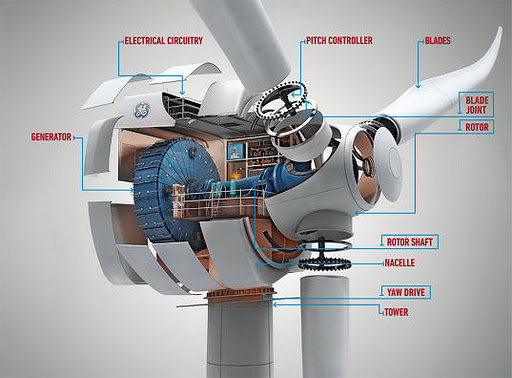
The wind turbines are there in their nice little clusters turning wind into the most expensive energy we’ve ever gotten involved in, costing consumers a fortune as our energy bills soar in order to pay for them and pay the operators for the privilege of them existing. And all because the ‘greenies’ religion doesn’t allow them to engage with cheaper and more realistic alternatives.
Anyway, it turns out that not only are wind farms generating little to no electricity most of the time because there’s not enough wind, but when there is wind they have to be switched off to avoid damage.
What?
Yes, if there’s even the slightest possibility that winds will exceed 80kph (50mph) then the turbines have to be switched off, locked down and forbidden from producing electricity.
Now, I somehow had the idea that with these huge winds buffeting Northern Britain, especially Scotland, the wind farms would be mad at it churning out huge supplies of electricity, enough to be stored to ensure the pensioners don’t freeze to death this winter. No, not the case. It’s the wrong kind of wind. Well, it’s the wrong amount of wind.
In the first instance, the turbines can’t actually operate in these strong gusts, and in the second, there’s not really anywhere or any way to store overproduced electricity. It just goes to waste if the National Grid can’t take it.
Compounded to this technical issue is the fact that the National Grid is forced to pay the wind farms for the fact it was unable to take their electricity. That gets passed on to us, the bill payers, and so we are effectively just being charged for windy days, not for actual electricity. The windier it is, the more we pay, even if we can’t use the electricity being over-produced. Crazy. It’s like being in a restaurant and being full, yet the waiter bringing you extra food you didn’t ask for, just can’t eat, and charging you for it even though you didn’t ask for it and couldn’t eat it.
In contrast of course, if the National Grid needs electricity and the wind farms are unable to supply it because there’s no wind, or the turbines are frozen and unable to operate in sub-zero conditions, tough, they of course don’t get ‘fined’ or face any financial penalty whatsoever. The ‘greenies’ religion has ensured they are above all that kind of thing.
So, when winds are forecast to reach over 80kph, even if they actually don’t gust that high, farms shut down. The shutting down process consists of turning the blades side on to the wind and locking them in place so the wind passes over what appears to it to be the thinnest point with no resistance.
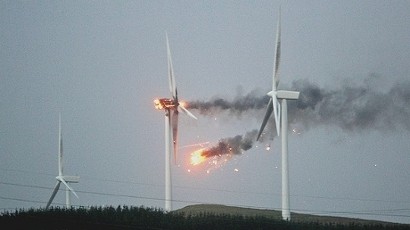
When things go wrong and a turbine isn’t shut down then it goes mad and catches fire (pictured). The fire of course completely destroys the interior causing tens of thousands of Pounds worth of damage, which we then have to pay for, and of course, an extended period of no longer producing electricity.
During the winds across Scotland, which reached 265kph (165mph) not only did this turbine explode and catch fire, hurtling huge flaming sections down to earth, but also another one normally towering over 90 metres in the air, just fell over. Luckily nobody was killed in either incident, although some homes had to be evacuated.
The ‘greenies’, of course, just shrug the incidents off with a dismissive, “Oh well!” However, had a similar incident of a conventional fossil fuel or, heaven forbid, a nuclear reactor’s turbine exploding occurred, they’d have been out there in their packs, scaling buildings to put their ‘occupy’ banners up, and the mainstream news media they control would have been all over it with super-graphics, talking heads, and a whole fever of doom and gloom. But, nothing.
I’ve nothing against wind farms, even though they are a bit dangerous. They are everywhere I look when I stare out to sea. I just wish they didn’t cost me so much, and I worry for those that are being sent into fuel poverty by the unfair advantage they have over the far more efficient and reliable methods of producing electricity.

 England's England