

There aren’t many radio stations left that aren’t broadcasting a ‘programme’ coming from a central studio and ‘networked’ across all the country. This is especially the case during ‘off peak’ hours.
Yet, an essential part of this networking is to prevent anybody from knowing. This is done by including ‘local’ sounding jingles or ‘links’ (the talkie bits you hear a few times an hour from a ‘presenter’).
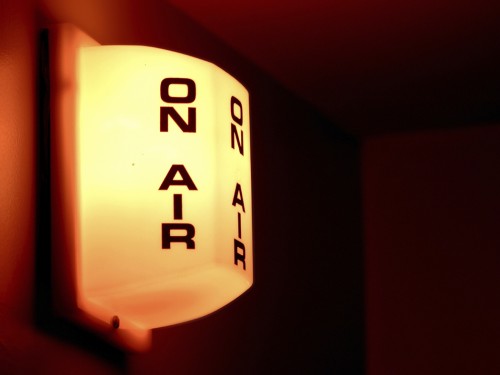
Now, I do understand that commercial breaks need to be split to play only the ‘local’ adverts. I mean, the annoyingly repetitive song about a Liverpool taxi company wouldn’t make any sense if it was broadcast 75 miles away in Leeds. It would be a waste and confusing.
Likewise a taxi company operating in Leeds can’t possibly be of interest to those living in Liverpool.
Not to mention, there’s an opportunity to maximise revenue by selling local advertising generally and then sitting it alongside the national or regional advertising that is heard ad nauseam on any and all commercial radio stations.
So, it’s not the commercials that I’m talking about.
But at the end of the commercials when a station ID goes out, or inbetween songs when the constipated voices say the station name, there is no mention of the fact that the one programme is networking across numerous stations. In addition, quite often the presenter will have pre-recorded himself saying “It’s Radio Rupert on 90.3…” “It’s Radio Banana on 106.1…” “It’s Radio Cockroach on 99.9…” ending on an ‘up’ and ‘open’ tone such that he can apparently continue the sentence. He triggers the pre-recorded first part of the sentence so that on each station networking his show, he is giving only that station’s ID. He then speaks the rest of the sentence ‘live’, for example “…playing you One Direction, bla bla bla.”
Using this technique, the presenter appears to all intents to be broadcasting locally and not actually networking across all the stations owned by that particular company.
But why?
Indeed, most often when the stray caller or texter does bother to make contact, the presenter has to be careful about revealing the contact’s location. So, Pete from Garston (Liverpool) asking for a shout out to Amy in Wavertree (Liverpool) to say good luck doing her homework becomes just Pete shouting out to Amy saying good luck with your homework. It would never do for listeners in (say) Leeds to suss that people in (say) Liverpool are also listening.
Why?
In contrast, the Mark Forrest early evening show that’s networked across all BBC local radio in England (from BBC Radio Leeds) ‘celebrates’ the fact that it is networked and takes the opportunity to ‘share’ bits that were previously only heard in one area, across all areas.
Apart from the complete lack of any actual content beyond segued songs, why doesn’t commercial radio do this? It could celebrate the ability to shout out to people in other parts of the country, at the very least.
Having said all that, one of the most important parts of the Mark Forrest programme appears to be the ability to act like a commercial radio station and provide localised jingles and trailers. Again, why is that important? But props for celebrating the networking in all other respects.
Yet why is the networking hidden by the commercial sector? Will people suddenly explode if they discover the presenter is reading out his liners from a studio at the other end of the country? No they won’t (even less so since virtually nobody ‘listens’ to the presenter anyway).
So, stop lying to the public.

 England's England