

Well, well, well. What have we here?
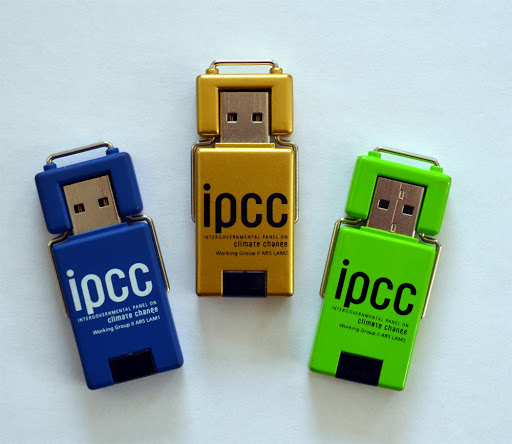 It seems that 661 files that make up the drafts of the next IPCC report (due to be spoon fed to us in September) have been leaked via these pretty data sticks to Donna Laframboise, an author and investigative journalist well known for exposing the IPCC and it’s infiltration by lobby groups rather than science.
The IPCC (Intergovernmental Panel on Climate Change) is supposed to prepare a kind of ‘State of the Planet’ pronouncement of the science looking at climate change and so on. Logically, this should be a summary of the latest peer reviewed scientific papers and the current thinking from a scientific point of view.
Sadly, what has been revealed is the overwhelming influence of Greenpeace and the WWF. These are just two of the extremely highly funded organisations that wish to promote the man-is-to-blame-for-global-warming-because-we-say-so concept that defies actual science, but helps push the idea that more funding for their types of organisations is needed, and how countries also need to be spending Billions chasing ridiculous ideas like carbon (the ‘dirty’ word they use to make carbon dioxide seem nasty) taxation.
Why are these people having any input whatsoever into the upcoming IPCC report? It is quite outrageous.
Quoting Donna Laframboise:
My 2011 book, The Delinquent Teenager Who Was Mistaken for the World’s Top Climate Expert, documents the IPCC’s numerous credibility problems. Among these is the disturbing influence of green activists on what is supposed to be a rigorous scientific body.
The Working Group 2 section of the upcoming IPCC report contains 30 chapters. The third draft of those chapters (known confusing as the Second Order draft internally) has not yet been written, but two earlier versions reside on these sticks [holding the leaked files]. What’s known as the First Order draft runs to 2,465 pages.
As part of its report-writing process, the IPCC invites feedback on its drafts from individuals it describes as “scientific expert reviewers.”
Most of these comments appear to be constructive, and will likely enhance the quality of the final report. But some of the individuals who took part are activists. Many of their suggestions amount to bald-faced attempts to embed activist source material – and activist perspectives – in a scientific document.
In other words, under the guise of “scientific expert review” the IPCC has facilitated an aggressive, behind-the-scenes, activist lobbying effort.
WWF PERSONNEL URGE THE IPCC TO CITE WWF PUBLICATIONS
The last major IPCC report, released in 2007, contained an embarrassing error about the rate at which Himalayan glaciers are expected to melt. This error received widespread media attention in early 2010, prompting prominent newspapers to call for the resignation of the IPCC’s chairman.
There’s nothing complicated about the Himalayan debacle. The IPCC authors responsible for writing Working Group 2′s Chapter 10 the last time around disregarded less alarming conclusions published in the peer-reviewed, scientific literature. They chose, instead, to rely on statements found in a publication produced by a green lobby group.
The group in question was the WWF. Still known in North America by its original name, the World Wildlife Fund, elsewhere it has rebranded itself as the World Wide Fund for Nature. Hardly a shoestring operation, the WWF has offices in more than 60 countries and a staff of 5,000.
The WWF is the outfit that brings us Earth Hour every March. Having funded four decades of its own activities with donations from the fossil fuel industry (its first corporate sponsor was Shell Oil), the WWF now thinks impoverished nations should leave their fossil fuels in the ground rather than using them to provide light, heat, and hospitals to their populations.
My book reveals how the WWF has, in the past, infiltrated the IPCC report-writing process. Two thirds of the chapters in the 2007 report included, among their personnel, at least one individual linked to the WWF. One third of the chapters were led by an WWF-affiliated author.
Neither the IPCC nor the WWF appear to have learned much about circumspection since then.
Susan Evans is employed by WWF Canada. She holds a Masters degree in zoology, but many of the comments she recently submitted to the IPCC are devoid of scientific content. For example, she sees this report as an opportunity to “foster a sense of stewardship and responsibility” toward the ecosystem (Chapter 00/comment 44).
On four separate occasions, Evans advises the IPCC to consult a 72-page handbook published by the WWF’s Global Arctic Programme (Chapter 00/comment 45, 2/727, 14/577, 15/367).
In another instance, she urges the IPCC to take into consideration a 246-page WWF document titled Buying Time. Its foreword encourages readers to become political activists (14/406).
On three occasions, Evans calls the IPCC’s attention to a third WWF-produced document about Pacific marine ecosystems (13/300, 26/260, 26/417). In three further instances, she points to a fourth report about climate change in Western Canada that the WWF helped create (15/367, 15/370, 26/316). Elsewhere, she urges the IPCC to consult a fifth WWF document, a 69-page publication about managing water supplies (15/455).
In a lengthy comment concerning Chapter 20, Evans editorializes about the need to “significantly reduce our current rate of development and consumptive behaviours” and urges IPCC scientists to consult the WWF’s latest Living Planet report (20/16.1 and 16.2).
I wrote about that very document soon after it was released, pointing out that the terms equality and inequality appear 28 times. In other words, it’s a political treatise.
Evans’ efforts to get WWF perspectives included in the IPCC report are reinforced by her colleague, Cassandra Brooke – whom the IPCC tells us represents WWF’s head office in Switzerland. A formal bio is difficult to locate, but one dated 2008 says she holds a PhD in geography.
In her capacity as an expert reviewer, Brooke thinks the IPCC should pay attention to the same WWF arctic handbook Evans promotes on four separate occasions (4/943).
She urges IPCC scientists to get their information about mangroves and climate change by visiting a WWF website, and is disappointed that the IPCC report “does not recognise that cultural and spiritual values are a form of ecosystem service” (4/1011, 5/1204).
But it is her remarks about species extinction that are especially revealing. Chapter 19 is a synthesis chapter. Its purpose is to summarize the findings of the other 29 Working Group 2 chapters. The job of those authors, therefore, is to accurately reflect what is written elsewhere.
Brooke, commenting on Chapter 19, gets it backward. She observes that the language in Chapter 4 “is very vague” and “inconsistent in tone” with what Chapter 19 says. It’s clear she thinks the wording in Chapter 4 should be strengthened rather than the hyped summary toned down.
Brooke is distressed because Chapter 4 “seems to be distancing itself” from the “strong statements” about climate change and species extinction that appeared in the IPCC’s 2007 report (4/664, 19/428). But this retreat is good news. As I have discussed elsewhere, the IPCC relied on a single research paper that had already been demolished by other scholars. (One famous biologist called it “the worst paper I have ever read in a major scientific journal.”) The IPCC not only failed to pay attention to those vigorous rebuttals, it declined to let readers know they existed.
One would expect scientific expert reviewers to be pleased that the IPCC is now behaving more responsibly. One would expect them to applaud the IPCC’s shift toward more solid evidence.
But Brooke is not a real expert reviewer. She is a WWF employee. And the WWF is OK with exaggeration. As it declares on its main website: “It is nearly impossible to overstate the threat of climate change.”
Read more and the full report here.

 England's England