

There seems to be a bit of wailing and banging of heads out there within the radio and techie anorak fraternity about the idea put forward by the House of Lords that we should move to all television being distributed via the internet.
 I’ve seen dummies being spat out of mouths and versions of Scotty from the original Star Trek series saying, “The technology’ll never take it. The whole broadband is gunno blow, Captain.” Yep, the idea has been met with ridicule by those who have closed minds.
Yet, I don’t understand why.
Here’s what we have at the moment. If we want to listen to the ‘radio’, we use a device that selects and receives a specific dedicated ‘broadcast’ (on DAB or FM). If we want to watch the ‘TV’ we use a different device that selects and receives a specific dedicated ‘broadcast’ via terrestrial transmitters (‘Freeview’) or from a satellite (‘Sky’).
All these ‘broadcasts’ are one way only, and they broadcast whether anybody’s listening/watching or not. They take up space, occupying ‘bandwidth’.
At exactly the same time, almost all homes have ‘bandwidth’ they use for the internet (broadband). It is there via fibre or wires, and doesn’t go away even if the household is not using it, but occupied watching TV via one of the methods we just mentioned. Again, a bit of a waste.
So, why not just push the TV programmes down the broadband and switch off the ‘broadcasting’ methods of delivery? Why not?
Now then. The first objection, quite justifiably, is that the reality is that not everywhere has decent broadband speeds. Large areas of the country, especially the more remote and rural, have none whatsoever or speeds slower than the old dial-up modems.
OK. We need to fix this. We need to get the entire country ‘up to speed’ as part of the process of closing down the ‘broadcasting’ occupancy of ‘bandwidth’ and moving everything over to the single ‘broadband’ delivery system.
Once we’ve fixed this, and that’s not going to be an easy task, then the first objection is dealt with.
The second objection seems to be the “whole ship’s gunno blow” objection. I remember this objection and protestation coming from those who were belittling the concept of video calling, or watching Youtube clips or TV on their mobile phones that everybody just does and accepts as normal when using 3G on a daily basis now.
Whoops. Hang on a minute. What have I just said? Yes, people already use their mobile phones to stream TV programmes, or use 3G ‘dongles’ plugged into their laptops/tablets to watch TV wherever they are. Oh, and to stream ‘radio’ from anywhere in the world too. It’s already happening and part of life.
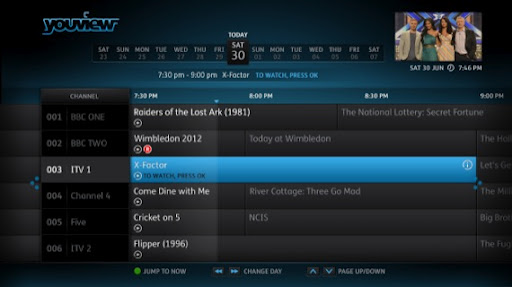
The new Youview boxes plugged into TVs will stream TV stations and the entire last 7 days of programming, some using the standard TV aerial, but most via the broadband into the home. Youview is an upgraded version of Talk Talk TV which provided TV over broadband for the last few years, and, well, just worked. Those with Talk Talk TV had no idea or concern about how the signal was getting to them. But, it was using their broadband, making the direct ‘broadcasting’ of TV stations redundant.
Hey. That’s the point.
If HD TV programmes can already be streamed via broadband, why the need for them to also be ‘broadcast’ in the old fashioned way? As a viewer ‘changes channel’ all they are doing is telling the server at the distant end to stop streaming the first channel and instead stream their new choice. Indeed, it’s easier than that, as there’s no need for a single server (as there was with, say, Talk Talk TV), as the Youview box intelligently switches between suppliers and servers without the viewer even knowing. That’s a bit like just typing in christopherengland.com to your browser and not having to know exactly where my blog is hosted or any of the other complicated bits of code and IP addresses. It just gets there without you needing to know how.
So, as broadband rolls out and becomes fatter and covers more of the areas currently missing out, there will soon be no need for anything other than fixed (fibre/wired) broadband or mobile broadband (4G and beyond) to bring us all the TV (and radio) we ever need.
We aren’t quite ready, but let’s hope that in 10 to 15 years time we’ll be looking back and laughing at the wasteful days when TV signals were ‘broadcast’ in the old fashioned way they currently are.

 England's England