

Back in the 1970s, I was the man behind a year long pirate radio experiment. We were attempting a weekly broadcast of “community-access” radio.
“Community-access” is something I believed in then, and it’s something I demonstrated I believed in when in the 1990s I designed a satellite radio station called Euronet. More about Euronet another time, but let’s step back to the 1970s.
Now then, the radio station was called Radio AMY. To be honest, it would have had a better name, but the guy who owned the initial transmitter had some fetish for a girl called Amy, and it had to be called Amy or he’d covet the transmitter. Happy days, eh?
We defined the radio station by giving it strict geographical boundaries. Although radio never adheres to such things, we deliberately ignored anybody making contact from outside of our self-imposed transmission area. We defined ourselves as covering the London Boroughs of Hackney, Islington, Haringey, Barnet and Enfield. Sometimes we did manage to cover it all. Most of the time we didn’t, but that didn’t really matter.
Transmissions in those days were for 6 hours, one day a week. It was only in the late 1980s that pirate stations were able to operate 24/7 free from being tracked and closed by the authorities. In the 1970s, most stations were raided at least every other week.
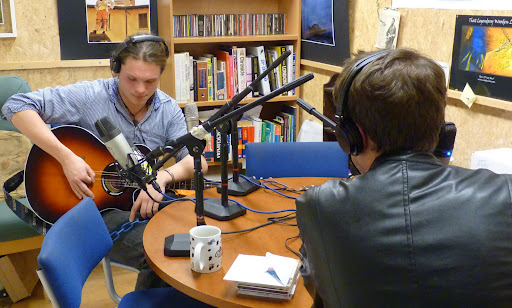 |
| (Not Radio AMY, but Brighton & Hove Community Radio. Is it real though?) |
Although there were other programmes, mainly those where we handed the mike over to young people, the primary format called the Community Chest (starting off life as ‘The Topical Thing’) was what the station was all about.
How to describe this.
Well, it was like a BBC local radio station, in that it would play songs, and then there would be talking bits inbetween them, probably in the ratio of 40% speech to 60% music each hour.
Now then, the songs would be a mixture of actual records, say around 30%, but they had to have been actually requested, and 70% of the songs were local unsigned bands or artists. Anybody could send a tape in and it would get on the air. After a while these started being requested instead of the ‘real’ pop songs.
The talking bits might be news and local commentary, or interviews, some produced by us, others, again, just sent in by the community. The range of subjects would toss and turn from grass-roots lefties going on about ‘the workers’, through to the more conservative folk ranting on about saving the greenbelt or old mansions. Or, it would be folk reading out poems or short stories they’d written. Or talking to local mediums or UFO spotters. Or doing Kenny Everett-esque funny sketches. Or … well, anything. It was community access radio.
Each hour was balanced to shuttle back and forth between the serious or the fun and silly, between the trivial and the tragic. It was like reading a local newspaper that also included music. In a way, we were just the co-ordinators for a flow of stuff that readily came from all parts of the community, with us acting more as conductors to a symphony of a whole army of contributors.
Around the same time as we were producing actual community radio with a phenomenal local press coverage, down in South-West London a more established pirate, Radio Jackie, was also waving the community radio flag. However, their demonstration of community radio was to imitate Radio One or Capital Radio with radio “deee-jaaays” playing safe pop records and oldies, interrupted every now and again by the reading out of chemist rotas and “What’s On’s”. That was how they defined community radio, and that’s what got noticed.
Sadly, this became the model for what many decades later actually became community radio. The AMY format of ‘community-access’ radio was forgotten, despite Radio AMY being a founding element of what later mutated into what is now known as the Community Media Association.
Today’s community radio is different amateurs turning up at the studio with their CD collection and playing it whilst trying to sound like any other commercial radio station. What’s the point?
If community radio is just the voluntary sector playing safe and well known songs, but sounding unprofessional compared to modern day commercial radio presenters, surely this is a complete waste?
The Radio AMY format was an easy one to produce. And this was back in the days of pause-editing everything on cassette. We didn’t even have open reel machines. Today’s mp3 world, digital editing, scheduling, and ease of production should make it a complete doddle. So why isn’t community radio doing this?
More importantly, why isn’t Ofcom asking community radio to do this?

 England's England
Agreed.
Too many CRs sound like the commercial big boys, and that's a missed opportunity.
You should check out an exception to the rule, though.
Although not as you describe above, Celtic Music Radio in Glasgow.
It strives to promote new music in an under represented genre and even has an audience on AM!
LikeLike