

That annoying Steve Conway has been at it again. I’ve reported in the past about how I have been a sufferer of Steve Conway Envy, and how, on the whole, I’m over it. I have it under control.
This doesn’t stop me stalking Steve on Facebork and his own blog. It’s not that I want to be him, or I’m jealous or anything, but he does write some fascinating observations. None are more fascinating maybe than his observations about the 25th anniversary of becoming Steve Conway (his nom de plume, when his ‘pluming’ was originally the news that he then read out via Radio Caroline from his real age of 23). [Please please please don’t skip the rest of my witterings in order to get to the link at the bottom or I really will suffer angst!]
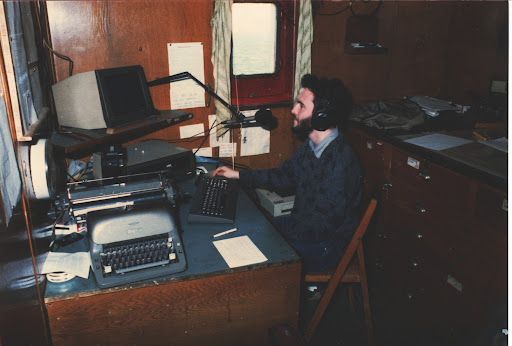 |
| (The keyboard in the foreground is part of a non-electrically powered device) |
His post is fascinating in two ways.
Firstly, I have no idea when I first took up the nom de plume of Christopher England. I have no idea when I did most things, to be honest, so ignorantly cross anniversaries without being able to mark them. Some of this is the way I’ve always been; looking forward and not looking back, and some of this is because I’m faulty compared to a lot of other humans. I don’t have long term memories of people, events and places. I know nothing else, so I don’t know if this is a bad thing, but I do know it makes me different to most people of my age. However, roughly speaking, my head can dip into about the last ten years of real memories, and memories older than those are ones I consciously keep re-teaching myself in order to, well, remember them.
This lack of real memory is why I can never compete with Steve and write a book full of, well, memories. Yeah, I could make one up, ‘cos I’m a far better writer than he is (f’narr), but it wouldn’t really explain or convey my actual feelings and thoughts at the time. I have no idea what they might have been.
The second and most interesting way that his latest blog post is fascinating is in his then and now observations, so eloquently put too. He refers to ‘information’ and its access. I’m probably agreeing with him but using a different label, communication. Of course, it’s information that is being communicated, so we are saying the same thing.
It is weird to think that when he first gave birth to the name Steve Conway there was no real communication compared to today. This had given rise to millennia of sooth-saying and parlour tricks to try to predict or guess things using supposed contact with ‘spirits’ or telepathy, coin tossing, or whatever it was dressed up as. Humans needed to know things about other humans, but they didn’t know, they couldn’t know. So they guessed and made it up in order to stop their enquiring minds from literally exploding over the problem of this unknown.
As Steve observes, these days you just look on Facebork. Not only do you discover how a person is and where they are, you can also talk to them even if they are fast asleep on another part of the planet. You are never out of touch.
I’m guessing this killed overnight the whole prediction industry, apart from those dealing with that final frontier, death, of course. Facebork seems to fall at the death hurdle. No matter how active a person might have been on Facebork pre-death, once death has taken hold the status updates don’t continue. Yet. I’m sure Zuckerberg is on the case.
For the more creepy stalking, my lovely lady and I use Google Latitude to instantly see on a map where each other might be. Also we text or call on route, or even when we are 2 minutes away. Possibly it’s all gone a bit over the top and there’s far too much communication, far to much information, since Steve Conway was born, but we just accept it as the norm. Twenty-five years ago most men would say goodbye to their other half as they left their home for work, and not speak to them again until they walked back in nine or ten hours later. If they were late, the angry wife would wait with a rolling pin knowing they’d been in the pub, yet not having heard from them.
These days my lovely lady and I never answer the doorbell unless it is for a takeaway delivery we are expecting. Everybody we know texts (or calls) before setting off to come to us. Again, some even text a five minute warning! Unexpected doorbell soundings are people trying to sell something, so we ignore them like spam.
Yet, when Steve Conway was born, most people would only be able to ‘keep in touch’ by randomly knocking on a person’s door and being invited in for a rapid bit of communicating, of information exchange. Tales of what he said and she said and what he’d done and they’d done and what others had repeated about others were the only way of getting ‘status updates’ about people you knew. The visitors would then go on their merry way, and add your ‘news’ to the tales they would pass on at their next stop, as you would add their news to the ‘status updates’ you verbally posted into the ears of the next person you saw. Heh, no wonder people would all so often get the wrong end of the stick about third party tales!
And then of course, there was the ‘see you next Sunday’ and then waiting in that next Sunday for the person to never turn up. Annoyed, you’d mutter and complain and it would take a good few weeks for it to filter back that the reason they didn’t turn up was because they were in hospital. Ok, true, when Steve Conway was born people had long been using fixed housephone to fixed housephone lines, or even phonebox lines to fixed housephone lines, and delays in communication had already been cut down considerably and it wasn’t quite that bad.
But what of all those millions of years before the telephone or telegraph? It must have been a nightmare, yet a clairvoyant’s dream.
Centuries ago, human beings were largely self-sufficient. We individually knew how to kill and eat. We knew what not to eat. We knew how to farm and cultivate. We knew how to survive.
As urban sprawl replaced ‘country living’, a whole new strand of humanity was created. A strand that now actually has no idea how to survive. Everything is done for them. A chicken is something pre-packed and pre-prepared with added stuffing and purchased from a supermarket. Urbanites have no idea how it got there. How would they survive in some post-apocalyptic situation which had wiped out most of humanity? Well, of course, they wouldn’t.
But how would today’s generations who have only ever known instant communication, survive if in some sci-fi type scenario, we no longer had the internet or telecommunications? What would they do?
[Ok, I’m done, time to go and read Steve’s excellent article here.]

 England's England