

I am not alone in not being able to understand these round things with shapes and a few numbers on that are supposed to tell me what the time is.
I notice that this failure is shared with Chris Moyles and his team when their Radio One breakfast show is broadcast from ‘locations’ around the UK, normally using a spare studio inside one of the BBC’s county-wide radio station buildings.
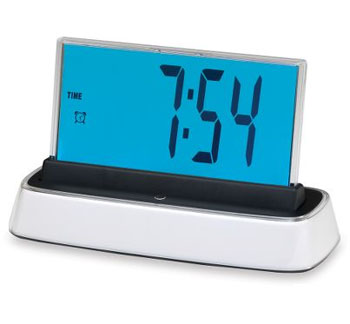 |
| This clock says it’s 7:54. Simples! |
Because the radio stations in these buildings provide programming for people over the age of 80, they are predominantly staffed by on-air teams in their 60s.
As they are so old, they have no idea how to read a digital clock, and so all the clocks in the studios have rotating sticks pointing to various shapes and numbers. For some reason they prefer to go through the huge mental recalculation and visualisation exercise involved in working out what the time is when it’s shown via one of these ‘analogue’ clocks.
At home I have no analogue clocks. Everything is digital, which is the way it should be. If I want to know what the time is I just look at one of the clocks, or my watch, and it’ll say, for example 09:21:30. This is dead easy to understand. It’s 09:21:30. There, all done. 09 is the hour, 21 is the minutes past that hour, and 30 is the seconds past that minute. It’s exactly the time it says, 09:21:30.
However, translating the analogue clocks is a nightmare. I have to look at this circle which has a number 12 at the top, a 6 at the bottom and all the other numbers at regular positions around its circumference. Inbetween the numbers are some regularly spaced little marks or dots. Heck, some analogue clocks don’t even have this much numbering information on them, typically only having a 3 and a 9 to supplement the 6 and 12!
 |
| This clock says it’s erm…erm…erm…oh, I don’t know! |
Anyway, from the centre of the circle there are two or three sticks pointing out to the markings around the outside. These are called hands, and there’s an hour ‘hand’ and a minute ‘hand’ and sometimes a ‘second’ hand. So, the first thing you have to do is determine how many hands there are. If there’s not three, then there’s no way of knowing what the seconds are.
There are times when there will appear to only be one hand. This is not worthy of panicking about and is usually because one of the hands has rotated to be on top of and obscure the other, however it could be because one of the hands has dropped off, so a careful inspection is needed to ensure that both hands are indeed one on top of the other, rather than one missing.
Having established that there are indeed two hands, one will usually be longer than the other. The long hand, traditionally called the ‘big’ hand, rotates around the circle taking an hour, and the short hand, traditionally called the ‘little’ hand, rotates around the circle taking 12 hours.
In the case of it being 09:21:30, then if there’s no third hand (known as the ‘second’ hand) we won’t know that it’s ’30’. We can however do a calculation, mentally dividing the tiny space between the dots into 60 parts and ‘guess’ at the seconds using this visualisation technique. But, let’s not worry about the seconds, there’s far too much else yet to do.
So, looking at the big hand we will see that it is pointing to a dot that is just below the number 4. That’s if we are lucky and a number 4 has been included in this particular analogue clock. Sometimes instead of the 4 there will be a thicker dot than the dot the hand is currently pointing to. Moving eyes up will find the 3, down will find the 6, and thicker dots will represent where the 4 and 5 would be had somebody bothered to put them there.
With the big hand pointing at one dot past the 4, it doesn’t mean 5, but 21. Even though the number 21 isn’t there, the nearest number is 4, and one has to multiply this number by 5 in order to calculate the minutes, and then add a minute for each of the additional dots beyond the number. In the case of our example, 4 times 5 is 20, plus one dot is 21. Through careful calculation and visualisation we have established that it’s 21 minutes past something.
Establishing what the hour is is equally tricky. The little hand won’t actually be pointing to an hour number unless it is dead on that hour. Instead it will be somewhere between two numbers (or a number and a thicker dot). In our example it will be pointing to the dot that’s the second one after the number 9, almost half way between the 9 and the 10. Little hands usually finish a long way from the numbers and dots around the outside of the circle, and so great care must be taken when visually tracing a path from the tip of the hand to the place in the scale of numbers and dots that it is pointing to.
The rule with the hour hand is to look carefully at where it’s pointing and then pick the lower of the two nearby numbers. In our example it is between 9 and 10 so we have to select the 9. The nearer it gets to 10 the trickier this becomes because 9 is still correct even though the hand is all but on the 10. Using this visualisation and calculation method we can establish that the hour is 9.
Put the 9 together with the 21 and we know it’s 09:21. Or at least it was when we first worked out which was the big hand and did the maths to work out what the minutes were.
However, my point still stands. All of this huffing and puffing can be simply avoided by staring at a digital display. If the display says 09:21 there’s nothing complicated to do. No maths, no visualisations, no calculations, no additional fiddling about is required. It’s 09:21.
Surely those who want to stick with analogue clocks should check themselves in for therapy or check out what other pointless things they do in their lives!

 England's England
Christopher!
Where would Mickey mouse be these days, without the analogue watch/clock? would you really force those jolly but vulnerable chaps onto the scrapheap to join the urban underclass? If they rioted, CCTV wouldn't save us- how would we know which one to prosecute? Would red shorts become the new hoodie?
LikeLike