

There is a logic that says the more I buy the cheaper things should get. In theory, buying 200 apples should cost me less per apple than the price of only buying one apple.
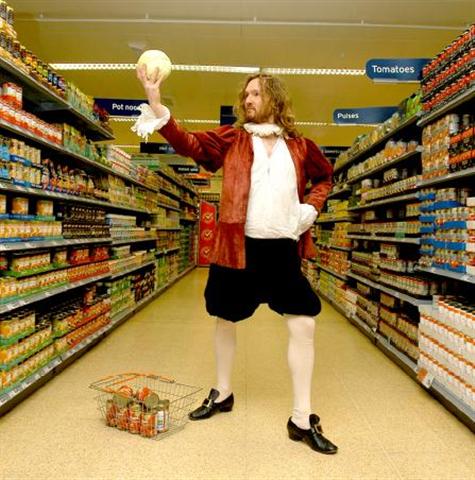 |
| Alas poor lettuce, I knew him well. 2 for or not 2 for? |
The logic, as far as I can see it, is that you are able to help the retailer shift more, which makes their buying power greater, such that they themselves can buy at a reduced rate. It’s all to do with economies of scale, or something.
Likewise, I always thought things were priced accordingly. If I was to buy a tiny box of Washing Powder it should end up costing me more per wash than if I lug home one of those gigantic hard to lift boxes of Washing Powder. The more you buy the cheaper it costs per wash.
But no. That is not the case. And I don’t understand why.
Without sounding like some loony leftie enviro-clone, surely a bigger container means less spent on packaging and so that can reduce the costs of production and manufacture, compared to spending a lot more on lots of smaller containers. The cost of the container has to be passed on to the consumer, so, again, logically the bigger box of the product should work out cheaper than buying lots of the smaller boxes of the product. Yet it doesn’t.
Ok, sometimes it does, but not often.
I’m talking about how things are priced in our major supermarkets. Asda, Sainsburys, Tescos, it doesn’t matter which, they are all doing it.
The most common way they’ll put this odd lower pricing on the smaller quantities of products is by using the “2 for £x” promotion. This will always be on the smaller sized container of a product. Let’s say there is a product available in 500g sizes and 1Kg sizes. They may sell the 500g size for, say, £1 whilst selling the 1Kg size for, say, £1.75. Therefore, buying two 500g containers of the product (making 1Kg, of course) will cost two lots of £1, as in £2. Meanwhile, buying a single 1Kg container of the product will cost £1.75, saving the buyer a whole 25p.
That makes sense.
However, where things get confusing is that they will have a near permanent offer available, selling two of the 500g containers of the product for, say, £1.50. This means that buying the two of the smaller containers saves 25p over buying one of the larger containers. The offer is never available on the larger sizes, only the smaller sizes. How and why?
This kind of thing happens with milk, and has been happened for years. In Asda (similar schemes operate in the other stores), where milk is stupidly sold by the old fashioned and out of date ‘pint’ measurement instead of litres, two containers of 4 pints (total 8 pints) are sold for £2. Or, if you prefer, 2 containers of 6 pints (total 12 pints) are sold for £3.50. So, buying 8 pints costs 25p per pint, whilst buying 12 pints costs 29p per pint. That’s 4p a pint more for buying more. How can that make any sense?
It’s not just on the “2 for …” offers. As a random example, I buy Bertolli. Normally I buy it in 1Kg tubs. These fit the space in the fridge nicely and are an ideal size for the knives I use to spread it with. Not that I’ve got an OCD or anything, but I don’t want the smaller sized tubs. However, right now the smaller 500g tubs are selling for £1.50 each, whilst the 1Kg tubs are £3.70. In other words, buy two of the smaller tubs, get the same amount of Bertolli, but save 70p. Eh? A good saving even if it means I have to put up with not being able to fit the knife in as nicely as I can in the larger tubs. I can handle that minor inconvenience, honest.
I could go on with plenty of other examples. I do wonder if those with large families who trot round the supermarket just picking up the biggest of everything, assuming they are getting the better prices, realise how much more they are spending. Or is that what it’s all about?

 England's England
You mentioned the size of milk containers Chris and complained about milk being available in pints or litres.
Have you noticed that 4 pints is a greater volume than 2 litres but the metric containers are sold at a higher price than the imperial ones?Odd.
I always look for the 4 pint version as it fits my old fridge better and it goes further and costs less.
LikeLike
2 litres is only 3.5 pints and invariably dearer – part of the decimal con started in 1971 (oh dear, we can only put things up 2.4d at a time!”), like petrol in litres (“oh dear, we can only put it up 4.5p a gallon at a time now!”) Still, at least 250g of butter is still slightly more than half a pound, but who decides that Tesco, Morrisons, ASDA & Sainsbury will all suddenly sell their value butter at £1.10 instead of 49p? Isn't that a cartel?
LikeLike