

London has the very impressive talking radio station LBC, owned by Global, and able to broadcast debate and discussion 24 hours a day, using quite a simple idea and format.
Liverpool, in contrast, is rapidly losing ‘local’ commercial radio as the stations cease their local output in favour of networking from places like Manchester. Bauer owns Radio City, CityTalk and Magic AM. Nothing broadcast in Merseyside over Magic actually comes from Liverpool any more. It is just a local transmitter for a ‘regional’ set of programming. This is in contrast to the days when a full complement of staff based in Liverpool were communicating with other Liverpudlians via Magic.
Radio City has some local programming by day, but evenings and weekends and overnights all come from Manchester. This is what happens for all the original ‘heritage’ stations across the North of England that are now all just providing about half their own programming, and for the rest of the time they are broadcasting exactly the same programming from, of course, Manchester.
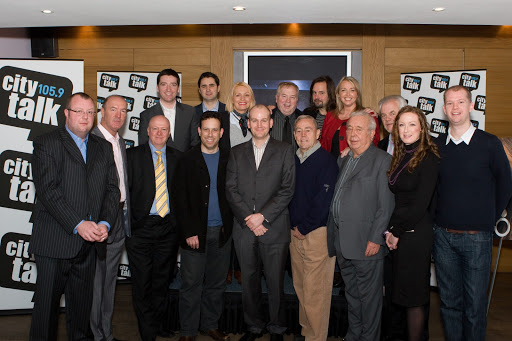 |
| (CityTalk from slightly happier days when people worked there) |
And finally in Liverpool there is this enigma that is CityTalk. Its format and agreed licence with Ofcom is unique. It is therefore not possible for the station to broadcast the same programming as every other station of its kind. There aren’t any.
(Although why it couldn’t re-broadcast LBC now that LBC is no longer available outside of London on DAB, I don’t understand either.)
So, what happens with CityTalk is that evenings and weekends and overnights it broadcasts a sort of ‘greatest hits’ automated output of pop oldies. This is quite professionally programmed, despite not quite being the kind of output you’d immediately associate with a talking radio station. The locally produced shouty voices remind us the station is CityTalk as they segue nicely into the songs. Yep, this playout computer has been properly programmed for a pop oldies format. Shame there’s none of the ‘talk’ part of the station name ‘CityTalk‘, but hey ho.
Daytime, however, attempts to comply with the original licence agreement to provide speech only. Where it once provided a full schedule of presenters and talking programmes, it now provides speech by presenting a 15 minute sequence of news, sport, weather and travel. This is read fairly well once an hour on the hour, refreshed every hour. The 15 minute sequence is ‘recorded’ and repeated over and over again until it gets refreshed. Usually the refreshed recording is only slightly different in content to the previous hour’s recording, with all the ‘reports’ exactly the same.
This is how CityTalk sounds by day. However, the production values are usually awful, with the jingles and identifiers from the imaging firing off all over the place, usually at the same time as the speech, interrupting and cutting it off mid sentence.
It’s almost as if they hand this day-part over to volunteers or trainees to operate. Or maybe it’s children. Or the cleaners. Or nearby market traders.
Certainly those involved technically don’t seem to have a clue. Day after day, week after week this happens. And of course, the newscaster will always be cut off mid-sentence if it’s the top of the hour and the pre-recorded loop is too long and it’s time to start the next hour’s pre-recorded loop.
During the football season, the station will broadcast very professionally put together sports and commentary programming. Usually these are simulcast with Radio City, but at times when both the local teams, Liverpool and Everton, are playing, CityTalk comes into its own by carrying different programming to Radio City. The football season hasn’t started yet, so CityTalk is at maximum pointlessness level.
One night this week from about 9:30pm CityTalk was broadcasting the output of the oldies computer and started simultaneously broadcasting the output of Radio City. This carried on until 10pm when both stations were scheduled to relay the same programme material, anyway.
Nobody complained of course because nobody’s listening.
However, it just seems so sad that Bauer makes no attempt to actually use the station to grow listeners to a local talk format. LBC works in London, so CityTalk could work in Liverpool, where Scousers need a place to talk their talk. And talk their talk is exactly what Scousers are good at. Yet, the opportunity is missed.
At the very least, tranches of the output could be given over to the broadcast of programming put together by the various voluntary groups that produce radio programmes that nobody ever hears, schools and colleges and those independent producers who want to experiment with speech programming. I mean, most of the output of British Public Radio might do the job. Anything rather than just waste the potential of the CityTalk frequency.

 England's England